
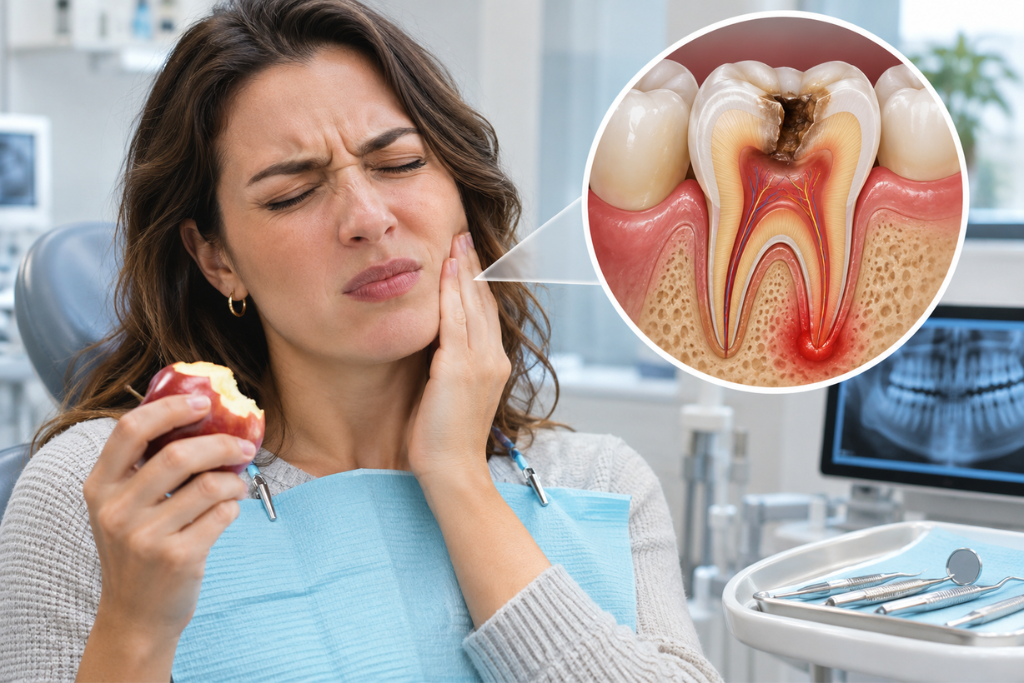
You bite into a roti, an apple, and suddenly one tooth begins to ache. You start to chew on the other side of the mouth. A week later you are still at it and it’s as if you have stopped thinking about it.
Many of us do this. Whenever the discomfort or pain appears, we think it is good to delay our visit. However, when a tooth causes pain when eating or chewing, it is not without its reason. It may be because of a decayed tooth, a tiny break, inflamed gums, or an inner tooth infection.
At R & R Home Of Teeth, a number of patients have told us they’ve waited several months to see us. In that time, the original problem has become just a little issue. If the nerve inside a tooth is severely infected, a root canal treatment in Kharar can save the tooth from extraction. Here are the six most common causes of pain when chewing:
1. A Deep Cavity
The cavity is on the surface of the tooth in the enamel layer. At first, it won’t hurt. As the hole gets larger and into the dentin layer of the tooth and near the nerve, biting down on a sweet, hot tea, or cold water causes pain. You may notice food stuck in the same spot all the time.
A filling can be done if you get to it early but if you leave it, the decay can access the nerve and then a root filling is necessary.
2. A Cracked Tooth
A crack is often never visible at all, not even in the mirror. What you feel is a bite that bites back – a quick throb, and perhaps even a more painful one when you release. It can be gone for days and then reappear – so most people ignore it.
Cracks often start from biting ice or hard nuts, grinding teeth at night, or an old knock to the mouth. Sometimes a small crack can be hidden with a crown. A bigger one that extends to the nerve in the tooth may require a root canal. If the tooth is cracked badly it may have to be removed.
3. Infection In The Tooth
Inside your tooth’s softer area is the pulp – the nerves and blood vessels. When germs are allowed to enter through a deep cavity or a crack, the pulp becomes infected.
This pain is different. It is a dull, continuous pain that persists between meals, especially at night. The tooth may be tender to the touch and you may notice a swelling or a “pimple” on your gum. It’s important to realise that infection in a tooth does not resolve on its own and any painkillers you take will only offer temporary relief as the infection remains.
4. Gum Problems
It may be that the tooth is healthy and the problem is the gum that surrounds it. Plaque and tartar can harden near the gumline causing the gums to become swollen, bleeding easily, sore, and red. They can also cause your bad breath even after you have brushed your teeth.
That way, the bone which is holding the tooth becomes unsteady, and chewing becomes painful. And a good cleaning in time can stop the process.
5. Grinding or Clenching Your Teeth
Is your jaw sore or do you wake up with a headache? Many people suffer from teeth grinding in their sleep and they aren’t even aware. This grinds the teeth down and puts a strain on the jaw so even soft foods can be uncomfortable.
Typically, a custom night guard will do the trick. You wear it during sleep and keep your teeth from the stress.
6. Old Fillings or Loose Crowns
Fillings and crowns aren’t for always. They can wear out, come loose or crack. When they no longer fit well biting exerts uneven force on the tooth underneath. Food and bacteria can also get underneath if the margin of a crown is uneven which leads to further decay. Does biting feel high or rough or does food constantly get trapped around a crown? Come in.
When Do You Really Need a Root Canal?

When the words “root canal” come up in conversation, they have some people running for the hills. Most toothaches, however, do not require this procedure. A root canal is only performed if the nerve inside the tooth is compromised or infected beyond repair.
The dentist numbs the region. Next, the dentist removes the contaminated pulp, cleans the inside of the tooth, and seals it. Finally, a filling or crown is put in place to safeguard the tooth. For most people, the procedure is rather like receiving a normal filling, and your tooth is preserved, allowing you to chew normally without risking a space.
It will be your dentist who makes the call, usually after a check-up and an X-ray, so you won’t need to take a guess.
If You See This, Don’t Wait
Visit a dentist promptly if the pain persists for several days, disturbs your sleep, or appears with a bump on the gum. Seek immediate medical attention if you have any of the following:
- Swelling on the face or fever
- Severe pain that does not ease
- Breathing or swallowing that is difficult (seek emergency medical care immediately)
Quick and Easy Methods to Protect Your Teeth
An easy way to help keep teeth healthy is to: brush twice a day with a fluoridated toothpaste and clean between your teeth every day don’t chew on ice cubes or pens or other hard objects. See your dentist twice a year, even if nothing hurts – lots of problems are painless at the start.
Final Thoughts
Chewing pain may be caused by a cavity, crack, infection, gum problem, grinding, or a worn-out filling. Some only need a small fix. Others need a lot more work. But none of them will go away on their own, and the longer you wait, the bigger and more expensive they become.
If it has become painful to chew, book a visit with R & R Home Of Teeth. A simple exam can determine the source and recommend the appropriate treatment so that you can go back to eating without discomfort.
